The Book On Palo By Baba Raul Canizares Pdf Download UPDATED
The Book On Palo By Baba Raul Canizares Pdf Download
Palo, also known as Palo Monte and Las Reglas de Congo, is an African diasporic faith that adult in Cuba. Information technology arose through a process of syncretism between the traditional Kongo religion of Primal Africa, the Roman Catholic branch of Christianity, and Spiritism. Initiates in the religion are termed paleros (male) or paleras (female).
Palo teaches the beingness of a creator deity, Nsambi or Sambia, who is uninvolved in human diplomacy. Central to Palo is the nganga or prenda, an fe cauldron into which human being bones, sticks, and other items are placed. This is believed to exist inhabited by the spirit of a expressionless private, who becomes the slave of the palero or palera. The practitioner commands the nganga to do their bidding, typically to heal but likewise to cause harm. Those nganga primarily designed for benevolent acts are baptised; those largely designed for malevolent acts are left unbaptised. The nganga is "fed" with the claret of sacrificed male animals. Various forms of divination are employed to make up one's mind messages from the spirits.
Palo is divided into multiple traditions, including Mayombe, Briyumba, and Kimbisa, each with their own approaches to the religion. Palo is nigh heavily practiced in eastern Cuba although is found throughout the island and has spread abroad, including in other parts of the Americas such as Venezuela and the The states. Many paleros and paleras also practice another Afro-Cuban religion, Santería. Practitioners have repeatedly clashed with law enforcement for engaging in grave robbery to procure human bones for their nganga.
Definitions [edit]
The name Palo derives from palo, a Castilian term for sticks, referencing the of import function that these items play in the religion's practices.[1] The faith is ofttimes likewise termed Palo Monte,[2] significant "spirits embodied in the sticks in the forest."[iii] Another term for the organized religion is Regla Congo, a reference to its origins amongst the traditional Kongo religion of the Bakongo people.[iv] Palo is also sometimes referred to equally brujería (witchcraft), both past outsiders and some practitioners themselves.[v]
Although its origins depict heavily on Kongo religion, Palo too takes influence from the traditional religions of other African peoples who were brought to Republic of cuba, such as the Yoruba. These African elements are combined with elements from Roman Catholicism, and from Spiritism, a French variant of Spiritualism.[6] Reflecting its African heritage, many practitioners refer to their homeland as Ngola.[iii]
Palo is an Afro-Cuban religion.[7] Information technology is one of iii major Afro-Cuban religions present on the island, the other 2 existence Santería, which derives in role from the Yoruba religion of W Africa, and Abakuá, which has its origins among the hush-hush male societies practiced among the Efik-Ibibio.[8] Many individuals practice both Palo and Santería.[9] Generally an individual is initiated into Santería subsequently they have been initiated into Palo; the reverse is not commonly permitted.[10] There are similarly practitioners of Palo who likewise exercise Spiritism.[xi] Palo likewise has commonalities with Obeah, a practice originating largely in Jamaica, and it is possible that Palo and Obeah cross-fertilised via Jamaican migration to Republic of cuba from 1925 onward.[12]
Practitioners are unremarkably termed paleros or mayomberos.[13]
Beliefs [edit]
The Palo worldview includes a supreme creator divinity, Nsambi or Sambia.[14] In the organized religion'south mythology, Nsambi is believed responsible for creating the first man and woman.[15] This entity is regarded every bit being remote from humanity and thus no prayers or sacrifices are directed towards it.[xv]
Deities play a much less important function in Palo than they do in Santería.[16] In Palo, the spirits of both ancestors and of the natural world are termed mpungus.[17] The spirits of the expressionless are more specifically also called muerto or nfumbi.[18] Some of these spirits take their own names, amid them Nsasi or Sarabanda or Baluandé.[3] Certain spirits may also take unlike aspects or manifestations, which have their specific names also.[3] Practitioners are expected to make agreements with the spirits of trees and rivers.[nineteen] The scholar Judith Bettelheim described Palo equally being "centered on assistance from ancestors and a human relationship with the globe, one's country, one's abode."[19]
The spirits of Palo are more often than not considered fierce and unruly.[ten] The spirit pact fabricated in Palo is more occasional and intermittent than the relationship that practitioners of Santería make with their deities, the oricha.[20] Practitioners who work with both the oricha and the Palo spirits are akin to those practitioners of Haitian Vodou who carry rituals for both the Rada and Petwo branches of the lwa spirits; the oricha, like the Rada, are even-tempered, while the Palo spirits, like the Petwo, are chaotic and unruly.[10]
The Nganga [edit]

A Cuban Palo nganga on brandish in a museum
A cardinal role in Palo is played by a vessel, sometimes a dirt pot or gourd,[iii] at other times an iron pot or cauldron, the calderos,[21] which is ofttimes wrapped tightly in heavy chains.[18] This is the nganga,[13] a term which in Fundamental Africa referred to a human being who oversaw religious rituals.[3] It is too known as the prenda, a Spanish term pregnant "treasure" or "jewel."[22] It is alternatively sometimes called el brujo ("the sorcerer"),[16] or the cazuela,[iii] while a small, portable version is termed the nkuto.[23] The terms prenda and nganga designate not only the vessel simply also the spirit believed to inhabit it.[24] The choice of nganga vessel can be determined depending on mpungu.[19] The nganga is deemed to be alive,[16] and is regarded as the source of the Palo practitioner's supernatural power.[25] The practitioners are termed the perros (dogs) or criados (servants) of the nganga.[26]
The contents of the nganga are termed the fundamento.[27] A key ingredient in these are sticks, termed palos, which are selected from specific trees.[25] The choice of tree selected indicates the sect of Palo involved.[25] Human being bones will as well typically exist included,[28] if possible including a skull, termed the kiyumba.[29] If basic of a deceased person are unavailable then soil from a dead individual's grave may suffice.[eighteen] Other material added can include animal bones, shells, plants, gemstones, coins, razorblades, knives, padlocks, blood, wax, aguardiente liquor, wine, quicksilver, and spices.[30] Soil from various locations is added, including from a graveyard, hospital, prison, and a market, equally may water from a river or the sea.[31] Oft the quantity of textile volition spill out from the cauldron itself and be bundled around information technology, sometimes taking up a whole room.[32] The mix of items produces a stiff, putrid odour and attracts insects.[31]
In Palo, it is believed that the spirit of the dead individual resides in the nganga.[sixteen] This becomes a slave of the owner,[10] making the relationship between the palera/palero and their spirit quite different from the reciprocal human relationship that the santera/santero has with their oricha.[10] The spirit volition and then protect the palero or palera,[25] and carries out the commands of their owner or their possessor'southward clients;[33] its services are termed trabajos.[18] They rule over other spirits, of animals and plants, that are besides included in the nganga.[25] Specific beast parts added are believe to enhance the skills of the nganga; a bat'due south skeleton for instance might exist seen as giving the nganga the ability to fly through the dark to conduct errands.[31]
The nganga can both heal and harm.[34] Those nganga intended for use to good ends undergo a baptism ceremony and are termed cristiana (Christian). Those intended for malevolent ends are left unbaptised and are termed judía (Jewish).[35] The latter are used for trabajos malignos, or harmful work.[36] The boundaries betwixt the two types of nganga are not ever wholly fixed, because the baptised nganga can withal be used for harmful work on rare occasions. [36] The medical anthropologist Johann Wedel noted that most of the paleros/paleras he encountered during the 1990s claimed that unbaptised ngangas were very uncommon by then.[36]
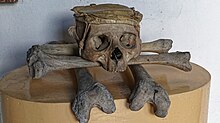
A human skull and basic displayed in the Museo de Orishas in Havana. Man cloth remains are included in the nganga of Palo
The nganga is kept in a domestic sanctum, the munanso,[18] typically formed in a cellar or a shed in the practitioner's backyard.[37] When an individual practices both Palo and Santería, they typically keep the spirit vessels of the respective traditions separate, in different rooms.[10] The nganga is "fed" with claret from sacrificed male animals;[xvi] this is poured into the cauldron.[31] Species used for that purpose include dogs, pigs, goats, and cockerels.[16] This helps to maintain the nganga's power and vitality and ensures ongoing reciprocity with the practitioner.[18] On at to the lowest degree one occasion, the palero/palera will give the nganga some of their ain blood.[32] Offerings of food and tobacco are too placed before it.[31]
The making of a nganga is a complex procedure.[25] Its components must accept place at specific times during the mean solar day and month.[25] A Palo practitioner would travel to a graveyard at night. There, they would focus on a specific grave and seek to communicate with the spirit of the dead person cached at that place, typically through divination.[38] They then determine to create a trata (pact) with the spirit, whereby the latter agrees to become the servant of the practitioner. Once they believe that they have the consent of the spirit, the palero/palera will dig up the bones of the deceased, or at to the lowest degree collect soil from their grave, and take it back home. There, they perform rituals to install this spirit inside their nganga.[18] When a new nganga is created, it is described as having been "born" from a "mother" nganga.[xvi] The practitioner enters a pact with the spirit of the nganga in a ritual involving them contacting the latter using divination and trance.[25] For a time the nganga is then buried, either in a cemetery or a monte area of nature, earlier being recovered.[25] When a practitioner dies, their nganga may be dissembled if it is believed that the inhabiting nfumbi refuses to serve anyone else and instead wishes to be gear up free.[39]
Palo teaches that menstruating women should be kept away from the nganga, for their presence would weaken information technology.[xvi] It is also explained that the nganga's thirst for claret would cause the woman to drain excessively, causing her damage.[16]
Birth and the dead [edit]
Palo teaches that the individual comprises both a physical trunk and a spirit termed the sombra ("shade").[15] In Palo belief, these are continued via a cordón de plata ("silver cord").[15] In Cuba, the Bakongo notion of the spirit "shadow" has merged with the Spiritist notion of the perisperm, a spirit-vapor surrounding the man trunk.[xv]
The expressionless, referred to as the egun, play a prominent role in Palo.[xi] It is held that ancestors can contact and help the living,[10] with paleros/paleras venerating the souls of their ancestors.[15]
Practices [edit]
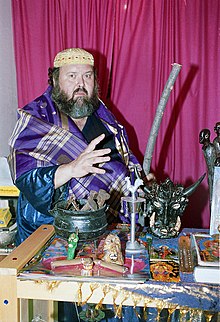
Baba Raúl Cañizares, a Cuban priest of both Santería and Palo photographed with his ritual paraphernalia, including a nganga
The negative rumours that often broadcast about Palo means that information technology is rarely practised openly.[16] The practices of Palo are oft secretive.[26] Groups practice their rituals in a edifice termed a casa-templo (house-temple).[23] Practitioners sometimes seek to protect the casa-temple by placing modest packets, termed makutos (sing. nkuto), at each corner of the block effectually the building; these packets contain clay from four corners and textile from the nganga.[23]
The language used in ritual deportment derives heavily from the Kongo language,[iii] while the phrase that practitioners greet ane another with is nsala malekum.[23] They also admit each other with a special handshake in which their correct thumbs are locked together and the palms come across.[23] Priests of Palo are called the Tata Nganga ("begetter nganga") or the Mama Nganga ("mother nganga").[26]
Ritual drawings [edit]
Drawings called firmas play an important role in Palo ritual.[23] These are deemed to be caminos ("roads"),[23] for they facilitate contact betwixt the worlds,[40] assuasive the mpungu to enter the ceremonial infinite.[23] The firmas are akin to the vèvè employed in Haitian Vodou and the anaforuana used by Abakua members.[41]
The designs of the firmas often incorporate ideas from traditional Kongo cosmology, including references the sun circumvoluted the World and the horizon line, regarded as the partition betwixt Sky and Earth.[42] There are many different designs; some are specific to the mpungu it is intended to invoke, others are specific to a particular casa-templo or to an individual practitioner themselves.[23] Before a ceremony, the firmas are drawn around the room.[23] The creation of these drawings are accompanied past chants chosen mambos.[twoscore] Gunpowder piles at specific points of the firma is then lit, with the explosion accounted to attract the attentions of the mpungu.[43]
Multiples of seven are considered sacred in Palo.[44]
Initiation [edit]
The first level of initiation into Palo is termed ngueyo; the highest is tata.[42] When the final stage of initiation is washed, a practitioner gets their ain nganga.[19]
Prior to the initiatory rituals, the initiate will exist done in h2o mixed with various terms, a procedure called the limpieza or omiero.[23] After the bath, the initiate will be clothed in items that reflect their status as a practitioner of Palo: trousers rolled up to the knees, a towel over the shoulders, and a bandana on the caput. The torso and feet are left unclothed.[44] At initiation, the name of the initiate's guiding spirit is revealed, along with the ingredients that volition be needed for their nganga.[42] Initiation into Palo involves a serial of rituals called rayamientos (markings).[45] These involve cuts beingness made on the body of the initiate,[fifteen] into which parts of the nganga's contents volition exist rubbed.[32]
Music [edit]
Music in Palo practices begins with wooden percussion instruments followed by drums. Examples are the catá, guaguá, and the ngoma, or conga. The cowbell, hoe, and plow are used as metallic instruments.[46]
Palo has been a means of transmitting the ritmas congos and influencias bantu, forms of Cuban drumming.[47]
Healing and hexing [edit]
Paleros and paleras frequently accept an avant-garde knowledge of plants and herbs found in Cuba.[48] They are believed capable of producing various powders.[34] When these powders are used to cause harms, their ingredients will ofttimes include dried toad, man hair, or fish bones.[34]
Clients may approach a palero or palera when they desire a rapid solution to a problem.[34] It may be that they want assistance in dealing with a problem such as state hierarchy or emigration issues.[49] Sometimes, a consultation with a Santería initiate will likewise result in advice about Palo.[34]
Spells are termed bilongos.[26] Practitioners engage in healing through the use of charms, formulas, and spells.[thirteen]
In Cuba, it is believed that affliction may accept been acquired by a malevolent spirits sent against the sick person by a palero or palera.[50]
Divination [edit]
Palo's practitioners communicate with their spirits via divination.[26] The mode of divination employed is determined by the nature of the question that the palero/palera seeks to ask.[42] Two of the divinatory styles employed are the ndungui, which entails divining with pieces of coconut shell, and the chamalongos, which uses shells. Both of these divinatory styles are also employed, albeit with unlike names, by adherents of Santería.[26]
Fula is a form of divination using gunpowder. It entails small-scale piles of gunpowder being placed over a lath or on the floor. A question is asked and so one of the piles is set alight. If all the piles explode simultaneously, that is taken as an affirmative answer to the question.[51] Another form of divination used in Palo is vititi mensu. This involves a small-scale mirror, which is places at the opening of a special animal horn, the mpaka, which is busy with beadwork. The mirror is then covered with smoke soot and the palero or palera than interprets meanings from the shapes that the soot forms.[15] Both fula and vititi mensu are forms of divination that Palo does not share with Santería.[26]
History [edit]
I know of two African religions in the barracoons: the Lucumi and the Congolese... The Congolese used the dead and snakes for their religious rites. They called the dead nkise and the snakes emboba. They prepared big pots called nganga which would walk about and all, and that was where the surreptitious of their spells lay. All the Congolese had these pots for mayombe.
— Esteban Montejo, a slave during the 1860s[52]
Subsequently the Spanish Empire conquered Cuba, its Arawak and Ciboney populations dramatically declined.[53] The Spanish then turned to slaves sold at Due west African ports equally a labor source for Cuba's sugar, tobacco, and coffee plantations.[54] Slavery was widespread in Due west Africa, where prisoners of war and certain criminals were enslaved.[55] Between 702,000 and one million enslaved Africans were brought to Republic of cuba,[56] the primeval in 1511,[57] although the majority in the 19th century.[58] In Cuba, slaves were divided into groups termed naciones (nations), often based on their port of embarkation rather than their own ethno-cultural background.[59]
Palo arises from the Kongo religion of the Bakongo people.[20] The Bakongo inhabit a region beyond Central Africa, that stretches from the southwestern Gabon, southern parts of Congo-brazzaville, southwestern Democratic Commonwealth of the Congo and northern Republic of angola (including the exclave of Cabinda).[60] [61] [62] Bakongo slaves formed the largest nation in Cuba between 1760 and 1790, when they comprised over xxx percent of enslaved Africans on the isle.[63] The nganga would probably have been ane of the very few weapons that the enslaved could use against their owners.[34]
In Spanish Republic of cuba, Roman Catholicism was the simply faith that could be legally practiced.[64] Cuba's Roman Catholic Church fabricated efforts to convert the enslaved Africans, but the teaching in Roman Catholicism provided to the latter was typically perfunctory and sporadic.[59]
Palo has its roots in the Congo Basin of Fundamental Africa, from where large numbers of enslaved Kongolese people were brought to Cuba where the organized religion evolved. It is mainly a product of BaKongo religion but has been influenced past other faiths.[65] Palo's liturgical linguistic communication is a mixture of the Spanish and Bantu languages, known equally lengua, bozal or habla Congo. [66]
Espiritismo has influenced Palo, especially the Palo Mayombe sect.[67] The Palo nganga has also been incorporated into a variant of Espiritismo, El Espiritismo Cruzao.[7]
During the mid-20th century, practitioners experienced police harassment.[23] Following the Soviet Union'south plummet in the 1990s, Castro's government declared that Republic of cuba was entering a "Special Menstruum" in which new economic measures would be necessary. As role of this, priests of Santería, Ifá, and Palo all took function in regime-sponsored tours for foreigners desiring initiation into such traditions.[68]
In 1989, the Cuban-American narcotrafficker Adolfo Constanzo and his group were found to have abducted and killed at least 14 people on their ranch outside Matamoros, Tamaulipas in Mexico, with the basic of their victims being placed into cauldrons for employ in Palo rituals.[69] Constanzo's group had apparently combined Palo with elements from Mexican religions and a statue of the Mexican folk saint Santa Muerte was constitute on the belongings.[lxx] Much media coverage incorrectly labelled these practices "Satanism."[71]
In 1995, the United states of america Fish and Wildlife Service arrested a Palo Mayombe high priest in Miami, Florida, who was in possession of several homo skulls as well every bit the remains of exotic animals.[72] In Newark, New Jersey, in 2002, a Palo practitioner was found to have the remains of at least 2 expressionless bodies inside pots within the basement, forth with items looted from a tomb.[73] A Connecticut Palo Mayombe priest was arrested in 2015 for allegedly stealing bones from mausoleums in a Worcester, Massachusetts, cemetery.[74] In 2021, ii Florida men robbed graves to get heads of dead veterans for ceremonies. [75]
Sects [edit]
Palo is divided amidst various different denominations or traditions. These include the Regla Biyumba, Regla Musunde, Regla Quirimbya, Regla Vrillumba, and the Regla Kimbisa.[13]
The Regla Kimbisa sect was founded in the 19th century by Andrés Facundo Cristo de los Dolores Petit, who was highly syncretic in his approach to Palo.[76] The tradition is founded on the principles of Christian charity.[77] In Kimbisa temples, information technology is common to discover images of the Virgin Mary, the saints, the crucifix, and an chantry to San Luis Beltrán, the patron saint of the tradition.[77]
Palo has also blended with Spiritism to create Muertería.[78]
Demographics [edit]
Palo is found all over Cuba,[79] although is particularly strong in the island'due south eastern provinces.[iv] Palo has also gained popularity among young people in various urban areas of the U.S.[12]
Both men and women are involved in Palo, but many women notice the community of practitioners to exist too masculinist;[80] in contrast to Santería, an attitude of adulthood is common among Palo groups.[81] Gay men are frequently excluded.[80] Observers have reported high levels of homophobia within the tradition, different the large numbers of gay men involved in Santería.[81] The scholar of religion Mary Ann Clark for example referred to a "pronounced homophobic atmosphere" in Palo.[eighty]
Reception [edit]
In Cuban guild, Palo is both valued and feared.[34] Palo has too been incorporated in popular culture, such every bit in Leonardo Padura Fuentes' 2001 novel Adiós Hemingway y La cola de la serpiente.[25] By the start of the 21st century, diverse Cuban artists are incorporating Palo imagery into their work.[19]
The being of Palo has impacted the burial of various individuals in Cuba. Remigio Herrera, the last surviving African-born babalawo, or priest of Ifá, was for case buried in an unidentified grave to prevent paleros/paleras excavation his corpse up for incorporation in a nganga.[82] Palo has been linked to a rash of grave robbing in Venezuela. Residents report that many of the graves at Caracas' Cementerio General del Sur have been pried open to have their contents removed for utilise in Palo ceremonies.[83]
References [edit]
Citations [edit]
- ^ Bettelheim 2001, p. 36; Palmié 2013, p. 120.
- ^ Wedel 2004, p. 189; Fernández Olmos & Paravisini-Gebert 2011, p. 88.
- ^ a b c d due east f yard h Bettelheim 2001, p. 36.
- ^ a b Wedel 2004, p. 53; Fernández Olmos & Paravisini-Gebert 2011, p. 88.
- ^ Wedel 2004, p. 53.
- ^ Fernández Olmos & Paravisini-Gebert 2011, pp. 89, 95.
- ^ a b Fernández Olmos & Paravisini-Gebert 2011, p. 215.
- ^ Mason 2002, p. 88; Fernández Olmos & Paravisini-Gebert 2011, p. 33.
- ^ Wedel 2004, p. 54; Flores-Peña 2005, p. 117; Fernández Olmos & Paravisini-Gebert 2011, p. 89.
- ^ a b c d east f one thousand Fernández Olmos & Paravisini-Gebert 2011, p. 96.
- ^ a b Fernández Olmos & Paravisini-Gebert 2011, p. 216.
- ^ a b Flores-Peña 2005, p. 117.
- ^ a b c d Fernández Olmos & Paravisini-Gebert 2011, p. 89.
- ^ Bettelheim 2001, p. 36; Fernández Olmos & Paravisini-Gebert 2011, p. 95.
- ^ a b c d e f grand h Fernández Olmos & Paravisini-Gebert 2011, p. 95.
- ^ a b c d east f g h i j Wedel 2004, p. 54.
- ^ Bettelheim 2001, p. 36; Fernández Olmos & Paravisini-Gebert 2011, p. 94.
- ^ a b c d e f g Palmié 2013, p. 121.
- ^ a b c d e Bettelheim 2001, p. 37.
- ^ a b Fernández Olmos & Paravisini-Gebert 2011, p. 88.
- ^ Fernández Olmos & Paravisini-Gebert 2011, p. 89; Palmié 2013, p. 121.
- ^ Wedel 2004, p. 54; Fernández Olmos & Paravisini-Gebert 2011, p. 94; Palmié 2013, p. 21.
- ^ a b c d e f g h i j k fifty Bettelheim 2001, p. 38.
- ^ Bettelheim 2001, p. 37; Fernández Olmos & Paravisini-Gebert 2011, p. 89.
- ^ a b c d eastward f k h i j Fernández Olmos & Paravisini-Gebert 2011, p. 90.
- ^ a b c d eastward f g Fernández Olmos & Paravisini-Gebert 2011, p. 94.
- ^ Fernández Olmos & Paravisini-Gebert 2011, pp. 89–90.
- ^ Wedel 2004, p. 54; Fernández Olmos & Paravisini-Gebert 2011, p. 90.
- ^ Fernández Olmos & Paravisini-Gebert 2011, p. 90; Palmié 2013, p. 121.
- ^ Fernández Olmos & Paravisini-Gebert 2011, p. 90; Palmié 2013, p. 122.
- ^ a b c d due east Palmié 2013, p. 122.
- ^ a b c Palmié 2013, p. 123.
- ^ Wedel 2004, p. 55; Palmié 2013, p. 123.
- ^ a b c d e f g Wedel 2004, p. 55.
- ^ Wedel 2004, pp. 55–56; Fernández Olmos & Paravisini-Gebert 2011, p. xc.
- ^ a b c Wedel 2004, p. 56.
- ^ Bettelheim 2001, p. 36; Fernández Olmos & Paravisini-Gebert 2011, p. 96.
- ^ Palmié 2013, pp. 120–121.
- ^ Palmié 2013, p. 126.
- ^ a b Fernández Olmos & Paravisini-Gebert 2011, p. 93.
- ^ Fernández Olmos & Paravisini-Gebert 2011, pp. 92–93.
- ^ a b c d Bettelheim 2001, p. 39.
- ^ Bettelheim 2001, pp. 38–39.
- ^ a b Bettelheim 2001, p. forty.
- ^ Fernández Olmos & Paravisini-Gebert 2011, p. 95; Palmié 2013, p. 123.
- ^ W-Durán, Alan (2008). "Cuban Ritual Music, African Influence in". In Juang, Richard Grand. (ed.). Africa and the Americas: Culture, Politics, and History. ABC-CLIO.
- ^ Hagedorn 2001, p. 47.
- ^ Wedel 2004, pp. 42, 45, 55.
- ^ Wedel 2004, p. 46.
- ^ Wedel 2004, p. 48.
- ^ Fernández Olmos & Paravisini-Gebert 2011, pp. 94–95.
- ^ Brandon 1993, p. 169.
- ^ Brandon 1993, p. 40; Hagedorn 2001, p. 184.
- ^ Brandon 1993, p. 44; Hagedorn 2001, p. 184.
- ^ Brandon 1993, p. 19.
- ^ Brandon 1993, p. 43.
- ^ Hagedorn 2001, p. 184.
- ^ Brandon 1993, p. 43; Hagedorn 2000, p. 100; Hagedorn 2001, p. 75.
- ^ a b Fernández Olmos & Paravisini-Gebert 2011, p. 34.
- ^ Rebecca K. Shrum, In the Looking Glass: Mirrors and Identity in Early on America, JHU Press, 2017, p. 138
- ^ "Kongo people". Encyclopædia Britannica.
- ^ Fernández Olmos & Paravisini-Gebert 2011, pp. 88–89.
- ^ Brandon 1993, p. 57.
- ^ Fernández Olmos & Paravisini-Gebert 2011, p. 35.
- ^ Erwan Dianteill. Kongo in Republic of cuba: the Transformations of an African Religion. Centre for the Interdisciplinary Written report of Religious Phenomena. pp. 59–fourscore.
- ^ Schmidt, Jalane (2017). "Regla de Palo". Africana: The Encyclopedia of the African and African American Feel (ii ed.).
- ^ Fernández Olmos & Paravisini-Gebert 2011, p. 209.
- ^ Hagedorn 2001, p. 8.
- ^ Chesnut 2012, p. 97; Introvigne 2016, p. 450.
- ^ Chesnut 2012, pp. 98–99.
- ^ Introvigne 2016, p. 451.
- ^ Pacenti, John (fifteen Feb 1998). "'Occult Cop' Walks Beat out on the Dark Side". Los Angeles Times . Retrieved 16 February 2018.
- ^ William Mcgowan (November 8, 2002). "Resting Without Peace". Wall Street Journal.
Just a month ago, Newark police raided the scruffy tenement at Central and Norfolk. Inside a basement worship room, 10-gallon Palo pots held at least two sets of human remains, including two skulls. ...
- ^ "Judge suppresses some evidence in human os theft case". The Seattle Times. Associated Printing. 16 February 2018. Retrieved 16 February 2018.
- ^ "Florida men stole heads of dead veterans from cemetery as part of 'black magic' organized religion, sheriff says". wwtv.com . Retrieved 8 Jan 2021.
- ^ Fernández Olmos & Paravisini-Gebert 2011, p. 97.
- ^ a b Fernández Olmos & Paravisini-Gebert 2011, p. 98.
- ^ Wirtz 2007b, pp. thirty, 32. sfn fault: no target: CITEREFWirtz2007b (help)
- ^ Hagedorn 2001, p. 22; Wedel 2004, p. 53.
- ^ a b c Clark 2005, p. 63.
- ^ a b Fernández Olmos & Paravisini-Gebert 2011, p. 270.
- ^ Palmié 2013, p. 115–116.
- ^ Romero, Simon (2009-12-11). "Palo (Faith) In Venezuela, Even Decease May Non Bring Peace". The New York Times . Retrieved 2010-05-21 .
Sources [edit]
- Bettelheim, Judith (2001). "Palo Monte Mayombe and Its Influence on Cuban Gimmicky Art". African Arts. 34 (2): 36–49, 94–96. doi:10.2307/3337912. JSTOR 3337912.
- Brandon, George (1993). Santeria from Africa to the New World: The Dead Sell Memories. Bloomington and Indianapolis: Indiana University Press. ISBN978-0253211149.
- Chesnut, R. Andrew (2012). Devoted to Decease: Santa Muerte the Skeleton Saint. Oxford and New York: Oxford University Press. ISBN978-0199764655.
- Clark, Mary Ann (2005). Where Men Are Wives And Mothers Rule: Santería Ritual Practices and their Gender Implications. Gainesville: Academy Press of Florida. ISBN978-0813028347.
- Dianteill, Erwan (2002). "Kongo in Cuba: The Transformations of an African Organized religion". Archives de sciences sociales des religions. 117 (1): 59–80. doi:10.4000/assr.2480.
- Fernández Olmos, Margarite; Paravisini-Gebert, Lizabeth (2011). Creole Religions of the Caribbean: An Introduction from Vodou and Santería to Obeah and Espiritismo (second ed.). New York and London: New York University Press. ISBN978-0-8147-6228-viii.
- Flores-Peña, Ysamur (2005). "Lucumí: The Second Diaspora". In Helen A. Berger (ed.). Witchcraft and Magic: Contemporary N America. Philadelphia: University of Pennsylvania Press. pp. 102–119. ISBN978-0812238778.
- Hagedorn, Katherine J. (2000). "Bringing Down the Santo: An Assay of Possession Functioning in Afro-Cuban Santería". The World of Music. 42 (2): 99–113. JSTOR 41699335.
- Hagedorn, Katherine J. (2001). Divine Utterances: The Performance of Afro-Cuban Santería. Washington, D.C.: Smithsonian Books. ISBN978-1560989479.
- Introvigne, Massimo (2016). Satanism: A Social History. Leiden and Boston: Brill. ISBN978-9004288287.
- Mason, Michael Atwood (2002). Living Santería: Rituals and Experiences in an Afro-Cuban Religion. Washington DC: Smithsonian Books. ISBN978-1588-34052-eight.
- Palmié, Stephan (2013). "Signal and Noise: Digging up the Dead in Archaeology and Afro-Cuban Palo Monte". Archaeological Review from Cambridge. 28 (one): 115–131.
- Wedel, Johan (2004). Santería Healing: A Journey into the Afro-Cuban World of Divinities, Spirits, and Sorcery. Gainesville: University Press of Florida. ISBN978-0-8130-2694-7.
Farther reading [edit]
- Ayorinde, Christine (2004). Afro-Cuban Religiosity, Revolution, and National Identity. Gainesville: Academy Press of Florida. ISBN978-0813027555.
- Barnet, Miguel (2001). Afro-Cuban Religions. Princeton: Marcus Wiener. ISBN978-1558762558.
- Boaz, Danielle N. (2021). Banning Blackness Gods: Police and Religions of the African Disapora. Penn Country University Press. ISBN978-0271089300.
- Cabrera, Lydia (1977). La Regla Kimbisa del Santo Cristo del Buen Viaje. Miami: Colección del Chicherukú en el exilio.
- Cabrera, Lydia (1986). Reglas de Congo: Palo Monte Mayombe. Miami: Ediciones Universal.
- Cabrera, Lydia (1983) [1954]. El Monte. Miami: Ediciones Universal.
- González Bueno, Gladys (1993). "An Initiation Ceremony in Regla de Palo". In Pedro Pérez Sarduy and Jean Stubbs (ed.). Afrocuba: An Anthology of Cuban Writing on Race, Politics and Culture. Melbourne: Ocean Press. pp. 117–120.
- Matibag, Eugenio (1996). Afro-Cuban Religious Experience: Cultural Reflections in Narrative. University Press of Florida. ISBN978-0813014319.
- Palmié, Stephan (2002). Wizards and Scientists: Explorations in Afro-Cuban Modernity and Tradition. Knuckles University Press. ISBN978-0822328421.
- Ramón Ocha, Todd (2010). Guild of the Expressionless: Quita Manaquita and Palo Praise in Cuba. University of California Press. ISBN978-0520256842.
- Vélez, María Teresa (2000). Drumming For The Gods: The Life and Times of Felipe Garcia Villamil, Santero, Palero and Abakua. Temple Academy Press. ISBN978-1566397315.
External links [edit]
- Kimbisa.org, roundtable discussions of issues in Palo, hosted by Palo Priests.
- Nganga.org, full general information on Bantu religions in the diaspora.
- Palo, Comparative African religions
- Palomayombe.org, in-depth information on Palo Mayombe.
- Palomayombe.com, full general information.
- Palo-mayombe.com, full general Palo Mayombe information.
- Palo, Congo, Inkisi at Curlie
- Video of Palo ceremony for Má Lango, too known as Madre de Agua, at a beach in Santiago de Republic of cuba Jul-2014 (YouTube)
DOWNLOAD HERE
Posted by: bradleywasoned.blogspot.com

